
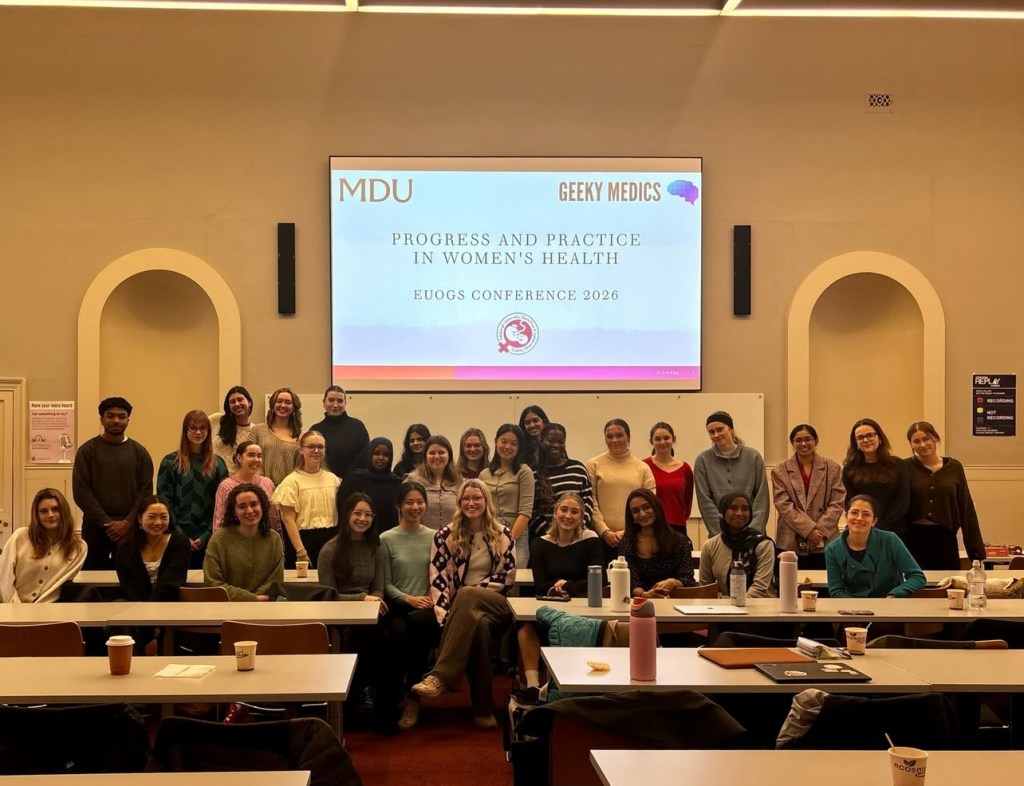
This weekend I went to a conference held by The University of Edinburgh’s Obstetrics & Gynaecology Society, during the workshop held by the Medical Women’s Federation Society, a conversation that was had stayed with me long after I left.
We were talking about menstrual health stigma in medicine, and how little space there still is for honest conversations about reproductive health within hospitals. What started as a general discussion ended up turning into something much more personal, especially for medical students on placement.
I was speaking to some fifth-year medical students when one of them said something I hadn’t really considered before. One of their biggest fears on placement wasn’t getting questioned on ward rounds or messing up a clinical skill. It was bleeding through their scrubs. That sentence sat with me because although it sounds small, it really isn’t.
Some students describe an unspoken pressure in medicine that you cope, you endure, and you don’t draw attention to your own body. Medical students feel this acutely as you’re already trying not to take up space and prove that you belong. So, when periods enter the picture, many students feel like they should deal with it quietly.
Some students who know they’re on their period while on placement, sometimes with significant pain, fatigue, or heavy bleeding, may still feel like they can’t ask for time off or adjustments. There’s this persistent idea that everyone gets periods and everyone manages, so you should too. But medically, that simply isn’t true. Some people experience minimal symptoms and others experience pain severe enough to vomit, faint, or struggle to function. Heavy bleeding can be genuinely debilitating, hence treating all of this as the same experience dismisses real biological variation.
Surgical placements came up repeatedly. Once you’re scrubbed into a case, especially a long one, you can’t easily step out. You can’t ask to go to the bathroom. You can’t change a pad or tampon when you need to. And many students don’t feel able to explain why. So, they stay in pain, distracted, and anxious. This isn’t just uncomfortable, it has potential safety implications. Severe cramps, blood loss, and fatigue affect concentration and physical stamina, so students ignoring their own physiological limits doesn’t make them better clinicians. Really, it has the potential to impact clinical performance and patient safety.
Hospitals are full of conversations about blood. We monitor it, measure it, replace it, analyse it. Yet menstrual blood still exists in a strange silence, as it is seen as personal, embarrassing, or inappropriate to mention in professional settings. But menstruation is physiology, it’s not a failure of resilience or professionalism and it’s not a personal inconvenience. It’s a normal biological process that can, for some, significantly impact day-to-day functioning.
I’m about to start my first year of medicine, with a background in reproductive biology. So, these conversations didn’t feel distant or theoretical, they felt like a preview of what I might face too. Hearing current medical students speak honestly about how they manage their reproductive health on placement highlights how deeply ingrained this silence still is. And if this is what students are experiencing now, it’s something worth questioning before it becomes normalised further.
Improving menstrual health in medical settings doesn’t mean lowering standards or asking for special treatment. It means practising realistic, evidence-based medicine. That might look like, normalising menstrual health discussions within clinical teams, allowing students and doctors to ask for reasonable adjustments without fear of judgement, acknowledging that menstrual pain and bleeding vary widely between individuals, or designing placements and surgical schedules that account for human physiology.
Most importantly, it means teaching medical students that advocating for their own health is not unprofessional, it is simply safe practice.
If healthcare environments can’t hold space for the reproductive health of the people working within them, that stigma can spill into patient care. Changing that culture starts with conversations that feel uncomfortable but which are necessary. Scrubs don’t make biology disappear, they don’t stop pain, they don’t stop bleeding, and they don’t make people less human.
Next week, I’ll be stepping into male reproductive health and looking at the future of male contraception, asking whether innovation is finally catching up.
REPROVA.

 REPROVA
Leave a comment