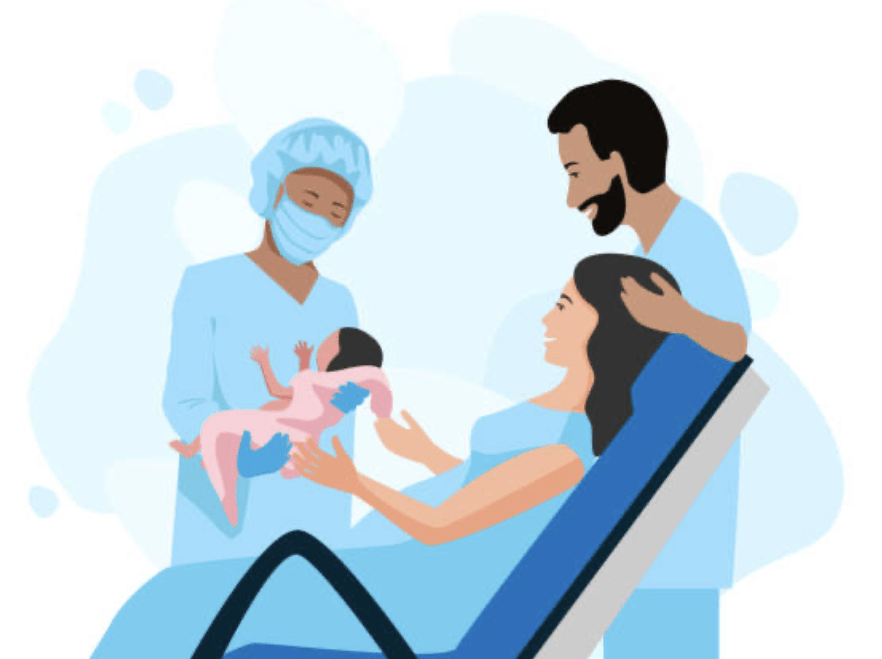
A few summers ago, I was a medical volunteer in a rural medical clinic in Zambia. My time at the clinic followed alongside the perinatal care of a local woman. The day she was in labour she was in immense pain with no option of epidural or relaxing medication like gas, just simple analgesics like paracetamol. The profound picture of a strong woman laying on a cracked and torn hospital mattress draped with a simple chitenge has since stayed with me.
At one point, I was asked to help assess how far along she was. Using my hands, I checked for cervical dilation, something that at its core, is a standard part of labour care anywhere in the world, but everything around that moment felt different. See, while the method may have been the same, the environment wasn’t – there were no continuous monitors, no immediate access to advanced interventions, and no range of pain relief options. What I was witnessing wasn’t unsafe, it wasn’t unusual, it was normal.
That experience has stuck with me for years, the realisation has always sat in my mind that for millions of women, there isn’t an alternative version of care. This is simply what reproductive healthcare looks like.
Reproductive health doesn’t change across borders and seas. Pregnancy, labour, and birth follow the same biological processes whether you’re in London or Lusaka. But the care surrounding those processes can look completely different as in higher-resource settings, labour often comes with access to pain relief, including epidurals, continuous monitoring, trained multidisciplinary teams, and rapid responses if complications arise. Conversely, in lower-resource settings, care can involve limited equipment, fewer healthcare professionals, restricted access to medication, and longer distances to reach facilities at all. This highlights that it’s not the biology that differs, it’s the access!
It’s important to understand that where you live can shape whether you can access contraception, whether you receive antenatal care, whether a skilled professional is present at your birth, and whether complications can be managed in time. This is a prime example of what reproductive health inequality looks like. In some places, conversations about reproductive health focus on choice, optimisation, and personalised care, whereas in others, they focus on access, distance, and true survival.
Chomba is a 29-year-old mother of four from Zambia, accessed family planning services for the first time nearly a decade into marriage. For years, the nearest health facility was a two-hour walk from her village, and that distance alone made it incredibly difficult for her to go to antenatal appointments or access contraception. Spacing out her pregnancies, something often taken for granted elsewhere, really wasn’t a realistic option. Her experience reflects that of many women, where access is not about preference, but proximity. However, her story also reflects change where with increased availability of reproductive health services, women like Chomba are now able to make decisions about their bodies and their families in ways that weren’t previously possible.
Over the past few decades, Zambia has made significant commitments to improving reproductive health. Following the 1994 International Conference on Population and Development in Cairo, the country joined a global movement to prioritise maternal health, family planning, and gender equality.
More recently, partnerships with organisations like the United Nations Population Fund (UNFPA) have helped expand access to essential reproductive health supplies. This has led to significant change such as increased availability of contraceptives, improved distribution of maternal health commodities, and a greater access to family planning services in some regions. Additionally, in certain districts, access to family planning has risen dramatically, giving women more autonomy than before.
The United Nations Population Fund (UNFPA) is a UN agency focused on improving sexual and reproductive health worldwide. Their work aims to support maternal healthcare services by providing contraceptives, strengthening supply chains for medical resources, and promoting gender equality and reproductive rights. In countries like Zambia, organisations like UNFPA play a key role in bridging gaps between policy and real-world access.
Progress and inequality can exist at the same time. As, despite these great advances, there are challenges that still remain. Maternal mortality rates are still higher than global targets, access to contraception is still limited for many, and adolescent pregnancy remains a significant concern. So, for some women, reproductive healthcare is improving, and for others, barriers are still shaping every decision. Needless to say, every step towards closing the reproductive healthcare gap is a step in the right direction.
Reproductive health is often discussed as education, awareness, and empowerment. However, the gravity of barriers to reproductive healthcare that women face in low-resource settings are rarely broadcasted to the western world.
Here are some ways to contribute to improving global reproductive health:
- supporting organisations working in maternal health
- advocating for equitable healthcare access
- increasing awareness of global disparities
However, the first step is simply understanding that these differences exist, because once you see it, you truly can’t unsee it.
I still think back to that moment in the clinic. The woman on a simple chitenge, the absence of equipment, the simplicity of it all. And not because it was shocking, but because it was normal. And that’s exactly the point, just because something is normal doesn’t mean it’s acceptable. Reproductive healthcare shouldn’t depend on where you are born.
REPROVA.


Leave a Reply