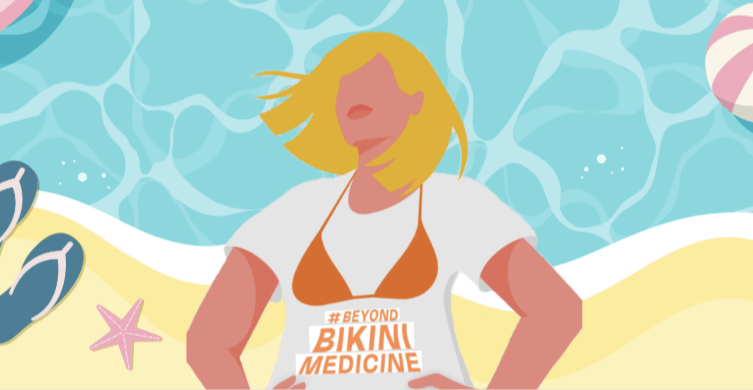
When we think about women’s health, why does the conversation almost always start and end at the bikini area? You know, periods, fertility, ovaries, the uterus, all wonderfully important players within women’s health. However, this becomes a problem when that’s all we talk about. This narrowing of women’s health to what sits underneath a bikini is often referred to as “bikini medicine”, a mindset rooted in historical biases within healthcare and research, where women’s health has been largely reduced to reproductive organs and the areas visible in a swimsuit. It also reflects the mistaken belief that women’s health only differs from men’s in the parts of the body that a bikini would cover. The truth is, your heart, your bones, your metabolism, and your brain don’t stop existing just because they don’t fit into that frame. Women’s health is not confined to the bikini, it is the whole body.
For decades, medical research and healthcare systems have largely centred male bodies as the default. When women were included, it was often through the lens of pregnancy, fertility, and menstruation. And while these areas are undeniably important, they’ve unintentionally shaped a system where women’s health is often treated as synonymous with reproductive health. This creates a kind of tunnel visioned focus, one that prioritises what’s visible and historically expected, while overlooking the rest.
This isn’t just a theoretical proposal, it’s a lived reality for women where symptoms are being dismissed and conditions are misdiagnosed. So, if you’re only looking at the bikini areas, you’re missing the bigger picture entirely.
The real killer: heart disease
When people think about serious health risks for women, heart disease rarely tops the list.
Cardiovascular disease is the leading cause of death in women globally, yet it is often under-recognised, underdiagnosed, and sometimes misinterpreted entirely. Part of the issue is that symptoms in women don’t always look the same as they do in men, as instead of the “classic” chest pain, women may experience fatigue, nausea, shortness of breath, or discomfort that doesn’t immediately cause alarm (Keteepe-Arachi and Sharma, 2017).
Bones before bikinis: osteoporosis
Bone health is another area that quietly falls outside the bikini conversation despite its huge impact within women’s health. Osteoporosis is a condition that affects millions of women where bones become weaker and more fragile. It commonly develops after menopause and often progresses without symptoms until a fracture occurs (Keen et al., 2026). By the time it’s detected, significant bone loss may have already happened. However, osteoporosis is preventable through nutrition, vitamin D, and weighted exercise, but for women to know this, there is a need for greater awareness and public health education (Keen et al., 2026).
Hormones & metabolism: more than a cycle
Despite common assumptions, hormones don’t just control your menstrual cycle, they influence your energy levels, metabolism, mood, skin, weight, and long-term health. For example, conditions like PCOS, thyroid disorders, and insulin resistance are all influenced by complex hormonal pathways but are often reduced to “period problems” when they are really whole body conditions with a wide range of effects (Hao et al., 2024).
Mental health isn’t a bikini issue
Mental health is still too often separated from physical health, especially in conversations about women. The two are in fact deeply connected as hormonal changes, chronic conditions, pain, and life stages such as pregnancy or menopause can all impact mental wellbeing. Conditions like PMDD highlight the need for this conversation further, as research over time has highlighted the switch from psychiatric or menstrual treatment to a greater holistic understanding of the relationship between the two (Mu et al., 2025).
What the bikini doesn’t cover
There’s an entire category of conditions that sit completely outside the bikini lens but disproportionately affect women. For example, autoimmune diseases, like lupus and rheumatoid arthritis are more common in women than men and can have a profound impact on the quality of life, but still often take years to diagnose (Angum et al., 2020).
The conversation about bikini medicine isn’t just about language or framing. When healthcare systems and conversations focus too narrowly, conditions are then picked up later and symptoms are taken less seriously, worsening outcomes. Healthcare professionals have a duty not to reduce women’s health concerns and complications to their reproductive organs, as this is how heart disease goes undetected, how bone loss progresses silently, and how chronic conditions are dismissed or misunderstood. See, the cost of “bikini medicine” isn’t just incomplete care it is missed opportunities to prevent, treat, and support women’s health.
The most important thing I can encourage is self-advocacy. Build your health literacy and try to understand your own body even if you don’t have a scientific or healthcare background, it is still yours to protect and support. Start by thinking about your health as a whole and ask questions that go beyond reproductive health like, how is my heart health? Should I be thinking about bone density? Are my hormones affecting more than just my cycle? How is my mental wellbeing?
Advocating for yourself doesn’t mean dismissing reproductive health, it means expanding the conversation because you are not just a set of organs. You are a whole system.
In summary, we have established that women’s health is not just what fits into a bikini. It is cardiovascular. It is metabolic. It is neurological. It is psychological. It is full-body and complex. This is bikini medicine, and it’s time we moved beyond it.
Next time, we’ll be looking at the relationship between geographic location and access to reproductive healthcare, taking a moment to recognise where barriers lie, and organisations that are playing a role to help break down these barriers.
REPROVA.
References
Angum, F. et al. (2020) “The prevalence of autoimmune disorders in women: A narrative review,” Cureus, 12(5), p. e8094. Available at: https://doi.org/10.7759/cureus.8094.
Hao, X. et al. (2024) “The relationship between thyroid hormones and insulin resistance in polycystic ovary syndrome women,” Gynecologic and Obstetric Investigation, 89(6), pp. 1–8. Available at: https://doi.org/10.1159/000539361.
Keen, M.U., Barnett, M.J. and Anastasopoulou, C. (2026) “Osteoporosis in females,” in StatPearls. Treasure Island (FL): StatPearls Publishing.
Keteepe-Arachi, T. and Sharma, S. (2017) “Cardiovascular disease in women: Understanding symptoms and risk factors,” European Cardiology, 12(1), pp. 10–13. Available at: https://doi.org/10.15420/ecr.2016:32:1.
Mu, E., Chiu, L. and Kulkarni, J. (2025) “Using estrogen and progesterone to treat premenstrual dysphoric disorder, postnatal depression and menopausal depression,” Frontiers in Pharmacology, 16, p. 1528544. Available at: https://doi.org/10.3389/fphar.2025.1528544.


Leave a Reply